
Dashboards were built for a slower kind of question.
They work when the organization already knows what it wants to measure. Revenue by quarter. Applicants by region. Open roles by department. Course completion by program. A dashboard is useful when the same view will be checked again next week.
Most important questions do not behave that way.
An organization may want to know which skills are starting to appear together, which research themes are moving toward industry, which technologies are gaining momentum, or which public datasets reveal a change that has not yet reached the strategy deck.
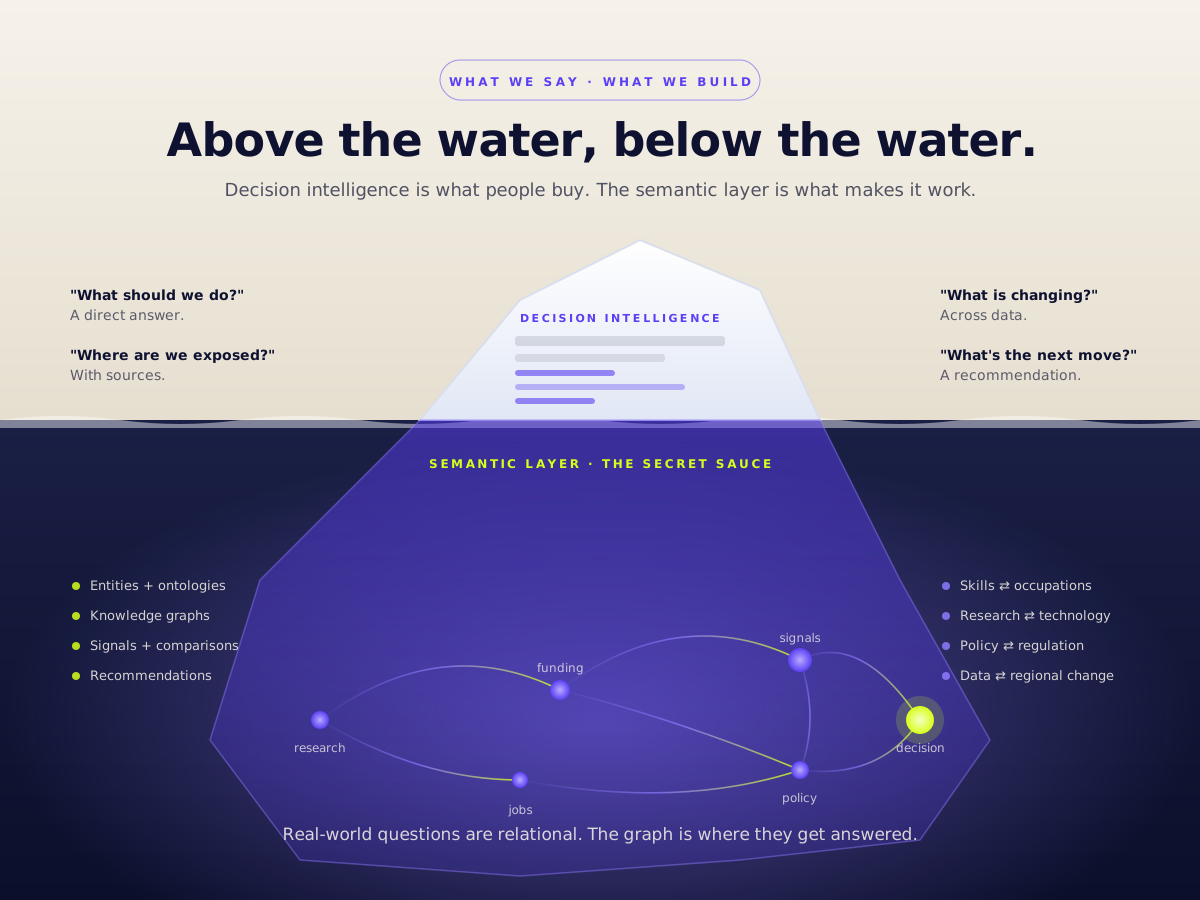
Those questions usually arrive as conversation.
What is changing?
Where are we exposed?
What should we do next?
This is the opening for vibe analytics: exploring data by asking questions in normal language, then letting specialized AI build the analytical path. No dashboard setup. No SQL. No BI training. Ask the question and get an answer built from comparisons, signals, knowledge graphs, and recommendations.
Vibe coding made intent the starting point
Vibe coding became the shorthand for building software through conversation with AI. Andrej Karpathy popularized the term in early 2025 when he described a style of coding where the builder talks to the AI, describes what they want, and lets the model generate much of the code. Later that year, Collins named “vibe coding” its Word of the Year.
The phrase took off because it named a real behavior change. People were no longer using AI only as autocomplete. They were asking it to build screens, write functions, connect APIs, explain bugs, and create working prototypes from rough intent.
The builder still matters. Judgment still matters. Architecture still matters. The starting point changed.
It moved from syntax to intent.
Once the first interaction becomes conversational, more people can participate. A founder can test an idea faster. A product manager can prototype a workflow. A designer can describe an interaction and see a version of it. The work becomes less about knowing every command and more about knowing what good looks like.
The numbers show how quickly the behavior entered the mainstream. TechCrunch reported in 2025 that YC managing partner Jared Friedman said roughly a quarter of companies in Y Combinator’s Winter 2025 batch had codebases where 95% of lines were generated by large language models. McKinsey also reported that 88% of surveyed organizations regularly used AI in at least one business function in 2025.
Software did not become effortless. The bottleneck moved. Asking better questions, reviewing outputs, and knowing what to keep became more valuable.
Analytics is heading in the same direction.
Dashboards answer known questions
Traditional analytics assumes someone has already translated the business problem into a data problem.
That translation takes work. Someone needs to find the right sources, clean the data, write the query, choose the visualization, and publish the result. When the same question comes back every month, the effort pays off.
When the question changes every ten minutes, the process starts to feel slow.
Consider a team trying to understand an emerging technology area. A dashboard might show patent counts, publication volume, or investment totals. Useful, yes. Then the next question arrives.
Which concepts are starting to connect across research, jobs, funding, regulation, and public discussion?
Which weak signals are appearing in more than one data source?
Which changes look like noise, and which ones deserve attention?
The first answer creates the second question. The comparison reveals a gap. The gap needs a recommendation.
Analytics becomes a dialogue.
Vibe analytics starts from that reality. The user asks a question in normal language. The analytical engine builds the route: map the concepts, compare the entities, detect the signals, and return something useful. The user can then push further.
“Compare these three technology areas and show which one has the strongest early signal.”
“Look across public datasets, reports, and project descriptions and show what themes are starting to converge.”
That is a different experience from browsing a dashboard and hoping the right view already exists.
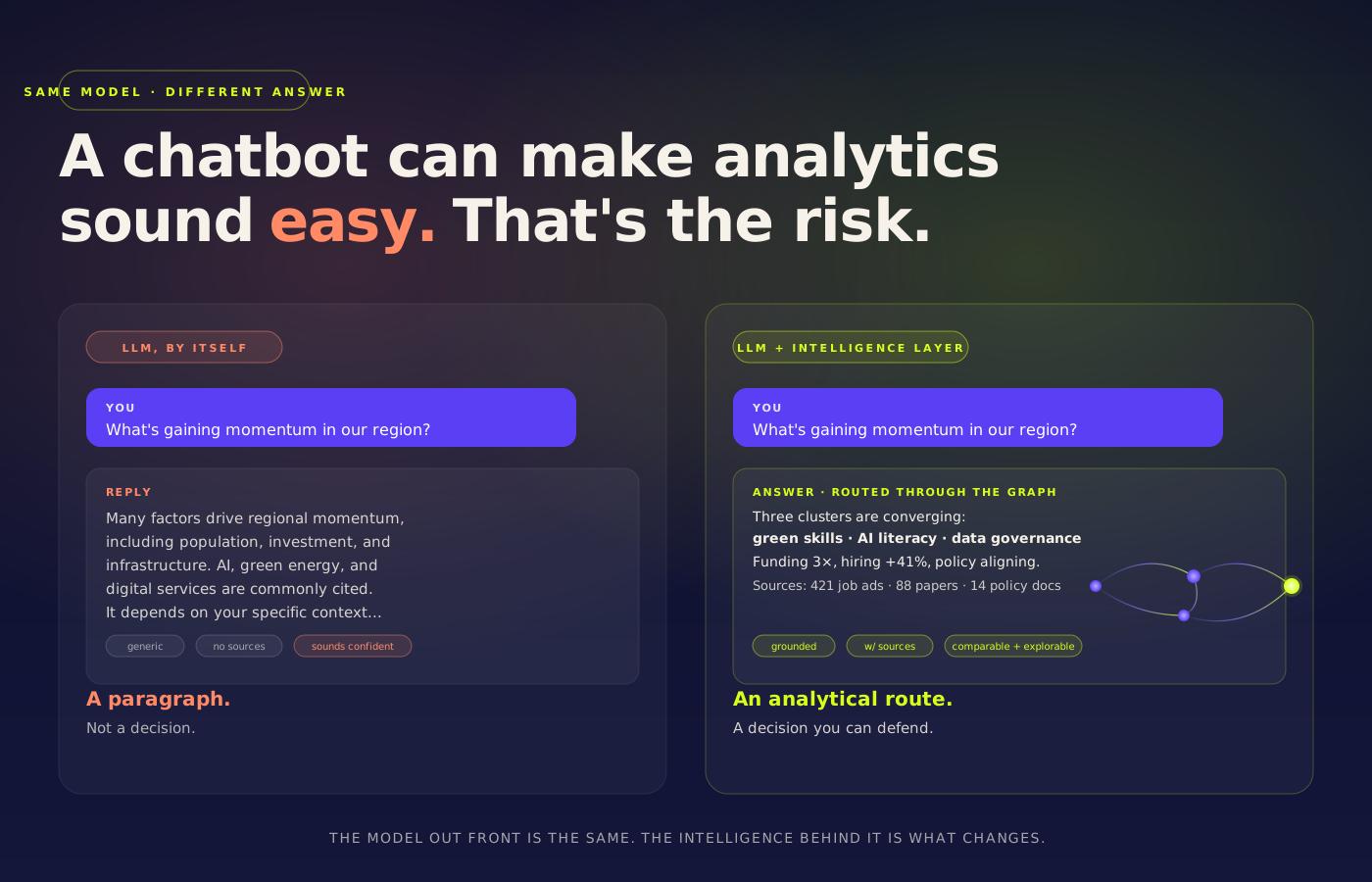
A normal chatbot can make analytics sound easy
That is the risk.
Ask a general-purpose AI model a question about skills, regions, technologies, research topics, or markets, and it may produce a confident paragraph. The paragraph may sound reasonable. It may also be too generic to support a decision.
This is where Headai’s work becomes interesting. The harder problem is turning messy text-based data into structured intelligence.
Headai’s work has long focused on knowledge graphs, natural language processing, and decision intelligence. Instead of treating documents as piles of text, Headai models the relationships between concepts. Skills connect to occupations. Research themes connect to technologies. Policy language connects to regulation. Company descriptions connect to market positioning. Public datasets connect to regional change.
That graph matters because real-world questions are relational. If a city asks what is changing in its economy, the answer may include skills, industries, education, investments, infrastructure, and policy language.
If a university asks whether its curriculum is future-ready, the answer may compare learning content against labor market demand, research trends, and regional goals.
If an investor asks where a technology is moving, the answer may connect publications, startup descriptions, job ads, funding themes, standards, and public procurement.
The same semantic layer can support workforce intelligence, curriculum analysis, technology foresight, market mapping, innovation policy, cluster analysis, or open-data exploration. The point is not one dataset or one dashboard. The point is that concepts connect in ways humans rarely see until the graph appears.
The user brings the question. Headai builds the analytical structure behind the answer: knowledge graphs, scorecard comparisons, signal detection, and recommendations.
MCP changes what the interface can become
Another shift is happening at the same time. AI assistants are becoming tool users.
The Model Context Protocol, or MCP, gives AI assistants a standard way to connect with external tools and data systems. Anthropic introduced MCP as an open standard for connecting AI assistants to the systems where data lives. OpenAI and Microsoft later moved to support it.
For non-technical users, the implication is simple.
They should not have to care which model sits in front.
Some teams prefer Claude. Some prefer GPT. Some prefer Gemini. That choice should not decide whether they can access serious analytical tools. With MCP, the assistant can become the interface, while specialized systems do the work behind it.
As Headai prepares to launch Space and MCP support, this points toward a more open way to work with analytical AI. Headai does not need to replace the user’s preferred AI assistant. It can become the layer the assistant calls when the question requires real analysis.
The user asks in the environment they already use. Headai provides the graph-based analytics. The answer comes back in a form the user can explore.
Most organizations do not want another isolated tool. They want their AI workflows to become more useful.
The real change is who gets to ask
Vibe analytics does not turn everyone into a data scientist. It gives more people a direct way to ask serious questions.
A policy team can explore how regulation, funding, and industry language are starting to overlap. A university can test curriculum assumptions against research and labor market signals. A company can compare customer feedback, job ads, product descriptions, and market positioning. An investor can scan technology signals across research, startups, jobs, and funding themes without reducing the world to a static market map.
The analyst still matters. The data engineer still matters. Governance still matters. In many ways, they matter more.
When more people can ask questions, the quality of the underlying data becomes more visible. The organization needs stronger data foundations, clearer rules, better models, and shared trust in how answers are produced.
For years, organizations have talked about data literacy. People need to read charts, understand metrics, and use data in decisions. Useful, but incomplete.
The next step is data conversation.
Can a leader ask a good question?
Can the system understand what kind of comparison is needed?
Can the answer show where the signal came from?
Can the user challenge it, refine it, and move from insight to decision?
Dashboards will not disappear. They are still useful for shared metrics, recurring reporting, and operational monitoring. They were never meant to carry the full weight of organizational curiosity.
Vibe coding showed what happens when people can turn intent into software through conversation. Vibe analytics brings the same pattern to data. The user asks. The system builds the analytical route. The answer becomes something to explore, not just something to read.
For Headai, this is the natural next step in building an intelligence layer for the data economy. The value is a way to turn fragmented, text-heavy, fast-changing data into knowledge graphs, comparisons, signals, and recommendations.
The future of data work belongs to the organization that asks better questions sooner, connects them to better intelligence, and acts before the signal becomes obvious to everyone else.
Written by Ivana Pesic
Source links
- Andrej Karpathy on vibe coding: https://x.com/karpathy/status/1886192184808149383
- Collins Word of the Year 2025: https://blog.collinsdictionary.com/language-lovers/collins-word-of-the-year-2025-ai-meets-authenticity-as-society-shifts/
- Y Combinator AI-generated code reference: https://techcrunch.com/2025/03/06/a-quarter-of-startups-in-ycs-current-cohort-have-codebases-that-are-almost-entirely-ai-generated/
- Garry Tan post on AI-generated code in YC W25: https://x.com/garrytan/status/1897303270311489931
- McKinsey State of AI 2025: https://www.mckinsey.com/capabilities/quantumblack/our-insights/the-state-of-ai
- Anthropic Model Context Protocol announcement: https://www.anthropic.com/news/model-context-protocol
- OpenAI and Microsoft MCP support coverage: https://cloudwars.com/ai/openai-and-microsoft-support-model-context-protocol-mcp-ushering-in-unprecedented-ai-agent-interoperability/
- Headai company positioning: https://www.headai.com
- Headai agentic architecture and knowledge graphs: https://www.headai.com/building-trustworthy-agentic-architecture/
- Headai data economy and skills foresight pilot: https://www.headai.com/2024/04/04/the-data-economy-is-already-here-lets-make-it-fair/